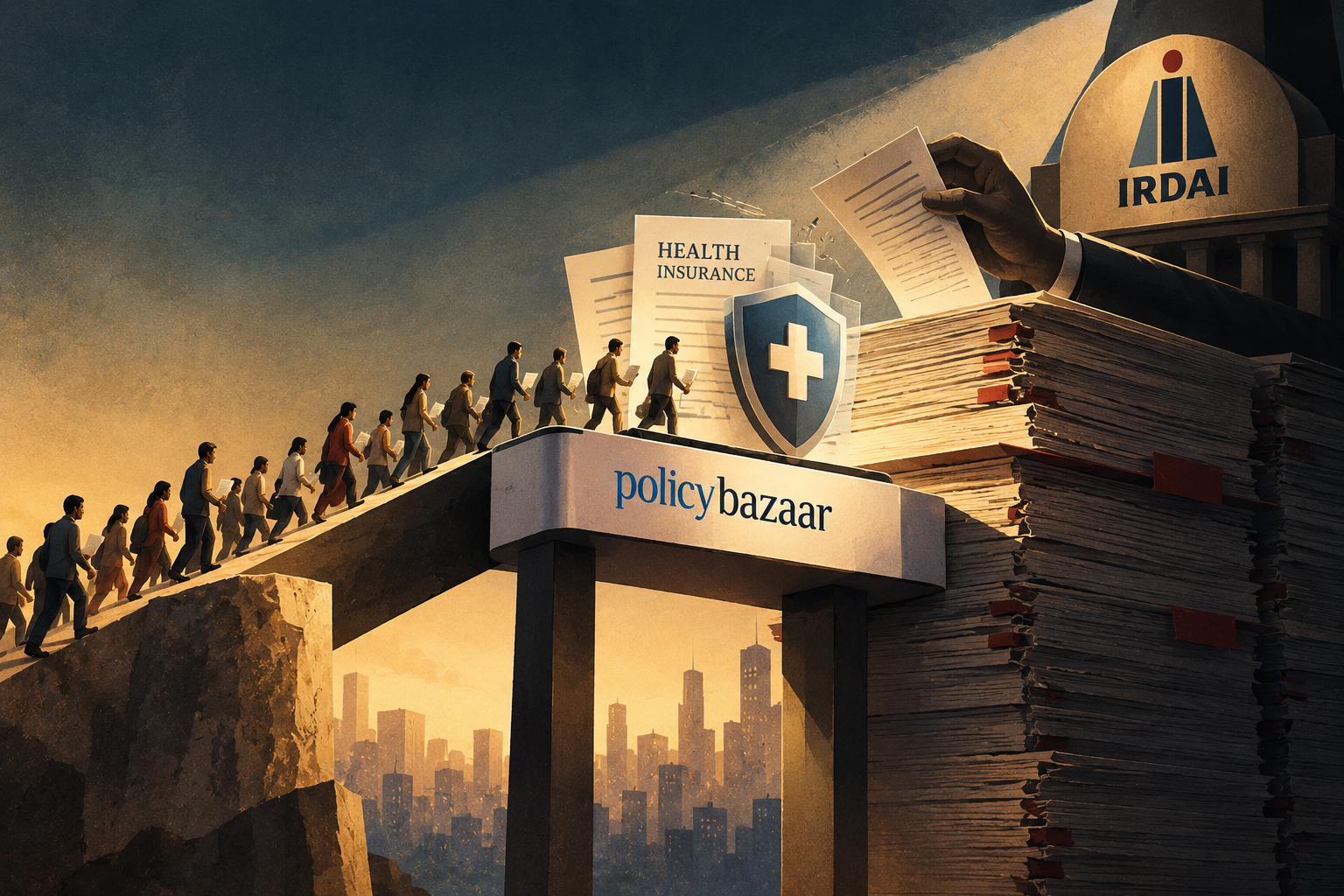
What does Policybazaar actually sell?
Not insurance. It has never carried a rupee of your risk.
What it sells is distribution. It finds the buyer, explains the product, completes the sale and services the renewal. For that, the insurer pays it a commission.
And here is what almost nobody understands about commission.
It is not a fee you pay on top. It comes out of the premiumiThe price a policyholder pays an insurer for cover, usually once a year. Commission is paid by the insurer out of this amount. you already paid.
The slice a platform keeps is called its take rate.
Policybazaar's runs at about 18.5%: of every hundred rupees of premium, roughly eighteen and a half stay.
That makes up for about 90% of their revenue.
Is Policybazaar’s business good?
On its operating numbers, yes.
Its share of retail health insurance went from 4.5% in FY22 to between 18% - 20% in FY26. And it did that while its take rate went up, from 17.5% to 18.5%.
The company raised its price and still quadrupled its share.
And if that wasn’t good enough: Insurers judge a book of policies by its loss ratioiThe share of premium that comes back out as claims.. A distributor sending bad clients wrecks it. Policybazaar's early mortality, deaths in the first stretch of a savings policy, fell from 14.4 per 10,000 policies to 1.8 in three years.
So not only do they bring customers, but they bring good ones. And the customers stay.
Persistency, the share of policyholders who keep paying year after year, runs at about 89% on health renewals, worth roughly ₹1,126 crore of annualised revenueiA recent period of revenue scaled up to a full year. It shows the yearly run-rate of the renewal book rather than a reported annual figure..
What does the IRDAI proposal change for Policybazaar?
The rent.
Think of Policybazaar as a very good shop on a busy street. Loyal customers, well-trained staff, shelves in order. But the shop has never owned the building. 90% of what it earns is a percentage, and that percentage was always set by the landlord.
In September the landlord sent a new lease. It sets a maximum commission for every product, and a different maximum depending on who does the selling.
Health, Policybazaar's biggest engine. By the paper's own count, the average commission brokersiLicensed intermediaries who compare and place policies from many insurers on the customer’s behalf. Policybazaar’s insurance arm is a broker. earned on retail health tripled between FY23 and FY25. The proposed ceiling for a platform is 15% on a first sale and 5% on a renewal now.
Motor. Third-party cover, the part the law makes you buy, drops to nil on a new vehicle and 2.5% on an old one, after going up 5x in two years.
And to add pain to the misery,
Every cap is lower for a company than for an individual. An agent selling a first-time health policy can earn 20%. A platform selling the same policy to the same customer gets 15%.
Second, the cap is all-inclusive. Incentives, awards, reimbursed selling costs, "brand value" payments and gifts all count.
A salary cap that also counts the company car and the Diwali bonus. Yikes, imagine that.
Show the full table · 6 rowsHide the full table
| Line | Platform | Agent | Platform as % of agent |
|---|---|---|---|
| Health, first sale | 15% | 20% | 75% |
| Health, renewal | 5% | 10% | 50% |
| Motor own damage, new vehicle | 5% | 10% | 50% |
| Motor own damage, old vehicle | 10% | 15% | 67% |
| Motor third party, old vehicle | 2.5% | 5% | 50% |
| Motor third party, new vehicle | Nil | 2.5% | 0% |
Are commission caps the only thing changing?
No. And the other clause may matter more.
Take Expenses of Management, or EoM, a ceiling on an insurer's total costs as a share of premium.
General insurers run at 32.1% today and must reach 20% within five years, roughly 38% of the cost base gone. Staff, technology and claims are fixed. Commission is the one line that flexes.
So, the squeeze on Policybazaar lands twice. 15% is a ceiling, not a promise. An insurer squeezed by its own budget will pay whatever it can get away with below it.
Why did IRDAI change the rules?
Because, from where it sits, the market underneath did not.
In April 2023 IRDAI scrapped the product-by-product commission caps and left insurers with one overall spending ceiling. Like a parent swapping a list of rules for a monthly allowance and trusting the child to budget.
As expected, and the paper says as much itself, the 2023 reforms "have not achieved their dual objectives" of better value for policyholders and wider coverage.
In life insurance sold through corporate agentsiCompanies, such as banks and NBFCs, licensed to sell policies for a limited panel of insurers, often alongside their own products like loans., new premium grew 28% between FY23 and FY25 while distributor pay grew 125%. Through general insurance brokers, premium grew 37% and commission 173%.
Remuneration, the paper says, is growing four to five times faster than the business it is paid on.
Show the full table · 2 rowsHide the full table
| Channel | Premium growth | Pay growth | Multiple |
|---|---|---|---|
| Life insurance via corporate agents | +28% | +125% | 4.5x |
| General insurance via brokers | +37% | +173% | 4.7x |
More money, roughly the same customers.
The regulator's case, then: distribution spend was not buying reach, and it was not buying customers who stayed. Whatever you make of the remedy, the diagnosis is well evidenced.
It also explains why the company is capped below the individual. The paper wants more feet on the ground. To quote the paper:
"To expand insurance, it is necessary to expand the agency force."
Will the IRDAI proposal work?
Strip the paper to its purpose and it targets three things: mis-selling, low penetration and affordability. Held against its own proposals, it seemingly does about half the job.
- a)
Mis-selling: yes, with teeth. SuitabilityiWhether a product actually fits the buyer’s needs and means. The paper wants that judgement recorded for every sale. must be documented. Commission is clawed back where mis-selling is established. Every policy carries the identity of the person who sold it. And insurance can no longer be made compulsory with a loan.
- b)
Penetration: partly, by implication. Cheaper distribution, cheaper premiums, more buyers. A chain of three links, and the paper directly controls only the first.
- c)
Affordability: not really. The paper caps what distributors are paid and what insurers spend. Nothing in the proposals as drafted obliges an insurer to lower a premium. Cutting the waiter’s pay does not shrink your bill unless the restaurant passes it on.
What about everyone else on the street?
Policybazaar is the biggest tenant. It is not in the worst unit.
Turtlemint does not sell to you at all. It runs an app through which hundreds of thousands of part-time sellers, called Point of Sale Persons (PoSPs), sell insurance in their own neighbourhoods. About 90% of its revenue is general insurance, mostly motor, where the caps bite hardest.
InsuranceDekho runs the same kind of network and sits in the same bind. In FY25 it paid its agents ₹836.8 crore on revenue of ₹1,290 crore and slipped to a ₹47.5 crore loss.
Then there are tenants who own their buildings: insurers, who pay commission rather than earn it. For Acko, Go Digit or ICICI Lombard, a cap is a rent cut. The day PB Fintech fell, ICICI Lombard rose 5.1%. Same paper, opposite side of the lease.
What can Policybazaar do now?
Three doors, and only one is interesting.
- a)
Buy the building: become an insurer. But due to regulations (surprise surprise) Policybazaar can send its own insurer at most a quarter of its business. A supermarket allowed to fill only a quarter of its shelves with its own label. All of the conflict, a quarter of the prize.
The record elsewhere is thin.
Check24, a large German comparison site, took a banking licence instead and was ordered to stop the one time it carried insurance risk.
At home, Paytm's 2020 deal to buy the general insurer Raheja QBE was called off in 2022.
Even a born insurer takes years: Acko spent about $458 million and nearly a decade before its first annual profit, in FY26.
So far, no comparison platform we could find, in India or abroad, has turned itself into a successful insurer. Some tried. Most groups that owned both halves chose to split them.
- b)
Run the kitchen instead: become a managing general agent (MGA). An MGA works for the insurer rather than the customer. It prices, underwritesiDecides whom to insure, on what terms and at what price. It is the insurer’s core judgement about risk. and binds cover on the insurer’s paperiUnder the insurer’s licence and balance sheet. The policy is the insurer’s, and so is the risk, even though the MGA did the pricing., while taking none of the risk. It earns a fee plus a share of the underwriting profit it generates. December 2025's amendment to the insurance laws wrote MGAs into Indian law for the first time.
Commission pays for volume. A profit share pays for quality of risk.
Guess which a platform with great risk selection like Policybazaar would rather be paid on.
The catch is that the rules for it do not exist yet.
- c)
Or charge the customer directly. "Opaque commissions paid by insurers and unknown to policyholders" to a fee paid by policyholders directly.
The open question
The franchise is real. 40% of India's new retail health cover does not run through one company by accident.
But every rupee of it arrives as a percentage somebody else now sets, and the paper does not just change the number.
It changes how you may find the customer, who pays the salesman, and whether a cheaper counter opens across the street.
The question is not whether this business survives the reform.
It is what it has to become to do it.