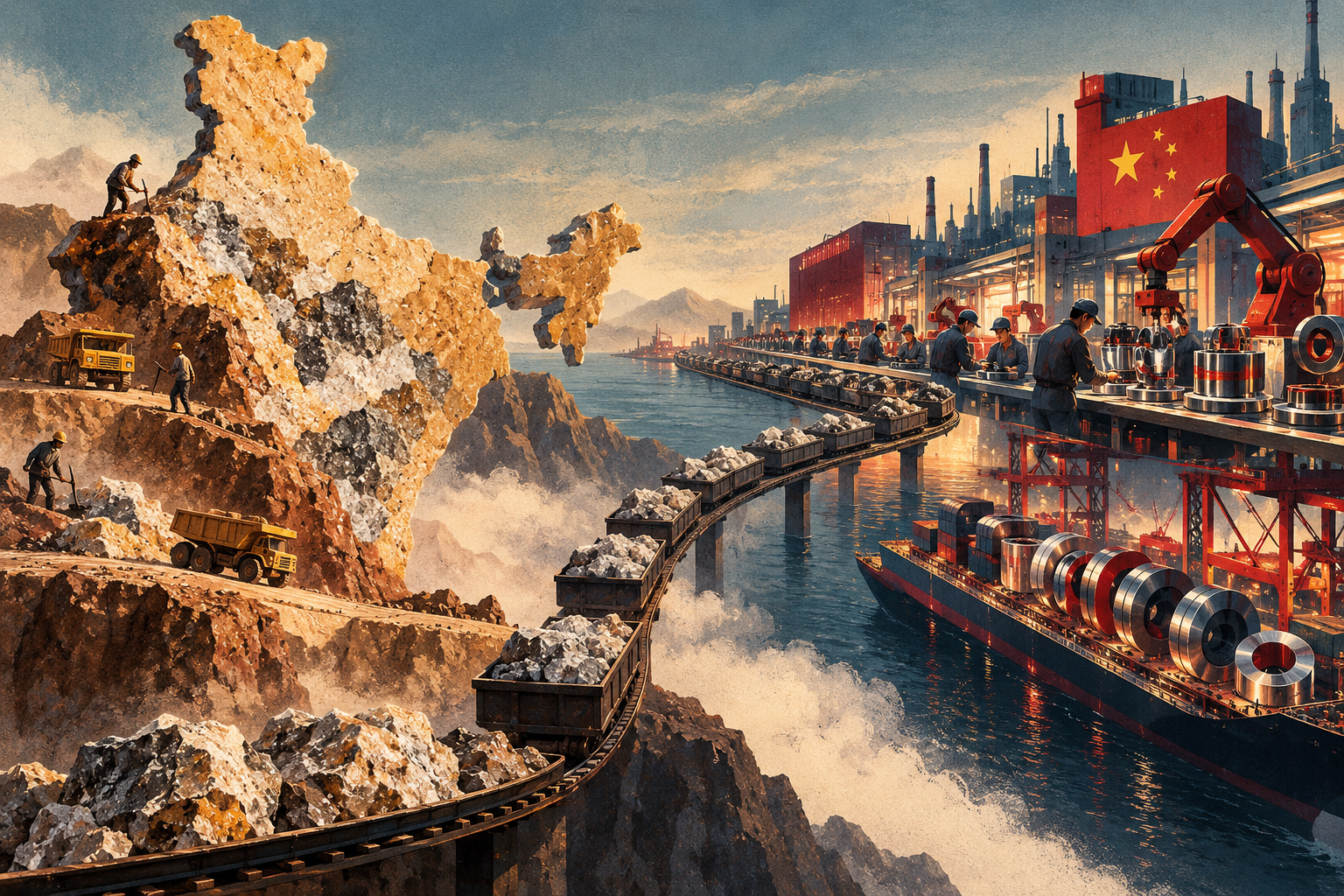
Every few weeks, a headline reminds us that India imports every rare earth magnet it uses. We read it and felt the sentence was hiding something.
So, we went to the ends of the earth (pun intended) and found a twist:
Rare, in this case, doesn't mean we don't have it.
We do. Loads of it. Which raises a far more awkward question.
Cerium, one of the 17 rare earthsiA family of 17 metals used in magnets, electronics and defence equipment. Most are not scarce in the ground; they are hard to separate from each other., is more common in the earth's crust than copper. So why the name?
Because "rare" was never about the ground. It is about finding ore rich enough to dig, and then pulling apart elements that behave almost identically. Think of sorting salt from sugar after someone has mixed the two sacks. Grain by grain.
The pinch in this business is in the middle and at the end, not at the mine.
China does 91% of the world's rare earth separationiThe chemical step that splits mixed rare earth ore into individual elements. The hardest and most concentrated step in the chain., about 99% of heavy rare earth processing and makes 94% of the magnets.
Show the full table: 4 rowsHide the full table
| Stage | China share | Source |
|---|---|---|
| Rare earth mining | ~60% (69% in Mining Technology's 2025 count) | IEA; Mining Technology |
| Rare earth separation | 91% | IEA GCMO 2026 |
| Heavy rare earth processing | ~99% | Skillings, Jul 2026 |
| Magnets | 94% | IEA GCMO 2026 |
Now look at India. We hold the world's third-largest rare earth reserve, roughly 6% to 8% of the global total. We mine less than 1% of what the world does.
Put the two together. 6.9 million tonnes in the ground, 2,900 tonnes dug up a year. At that pace the reserve lasts about 2,379 years.
Picture a pantry stocked for 2,379 years, and a household eating a spoonful a day.
Does that say more about the household, or the pantry?
How does a patch of ground become a mine?
Until 2015, India handed out mineral rights largely on a first-come basis. Since then, by auction.
In 2023 the Centre took the power to auction critical mineralsiMinerals an economy cannot easily do without and whose supply could be cut off, because it comes from a few countries. India's list has 30. sites, while the states still grant the leaseiThe legal right to mine a block for a fixed period. and keep the money.
The auction works like leasing out a field for a share of the crop. Companies bid the percentage of the value of every tonne sold that they will pay the state, on top of the royaltyiA fixed charge a miner pays the state on every tonne it sells.. Highest bid wins.
Winning the auction is the short and easy bit.
Once the winner is named, the Ministry's own deadlines allow 30 days for a letter of intentiThe state's written promise to grant the lease to the winning bidder, once conditions are met., six months for a mining plan, 18 months for environmental clearanceiCentral approval that a project's impact on air, water and land is acceptable. and 12 months to sign the lease. That is about 37 months, before forest clearanceiSeparate approval needed when a block sits on forest land., which has no published clock at all.
Show the full table: 6 rowsHide the full table
| Step | Deadline | Months |
|---|---|---|
| Letter of intent | 30 days | 1 |
| Mining plan | 6 months | 6 |
| Environmental clearance | 18 months | 18 |
| Lease signing | 12 months | 12 |
| Forest clearance | No published clock | n.a. |
| Total, before forest clearance | ~37 (derived) |
Take Hindustan Zinc. It won the Jhandawali-Satipura block in May 2025. In April 2026 it was still waiting for its license deed.
Then a second clock starts. No production within two years of signing, and the lease can lapse.
So how many projects actually make it through the door?
Why don't companies mine more often?
Start with the entry test. An auction goes ahead at the first attempt only if at least three technically qualified biddersiCompanies that pass the eligibility checks (Indian registration, minimum net worth) and may bid. turn up. Of the 81 auction offers made in the first five rounds, from November 2023 to May 2025, 34 cleared that bar.
Why stay away?
Bidders price what they cannot see. By November 2024, 49 different blocks were offered. About 90% of those 49 blocks had no clearly defined resource, and only about one in ten mining blocks had been surveyed well enough to mine.
It is like bidding for a house after seeing only the gate.
Then there is the clock. Worldwide, a mine takes about 16-18 years to go from discovery to output. India's quoted figure, 14 to 15 years, sits around that band.
Speed is not where India stands out then, we take roughly the same amount of time to go from discovery to first output. Conversion is.
Of the 132 commercial coal blocks allocated since 2020, 15 are producing. 11.4%. Across all minerals, estimates of blocks actually operating run at roughly one in seven.
Now the credit, because it is due. Since 2023 the rules have been loosened in the bidder's favour at least seven times: lower deposit caps, a second attempt with a single bidder, no premiumiThe share of sale value a winner pays the state on top of royalty. It is what the auction bids on. on minor by-product minerals, faster refunds, a shorter window to sign a lease.
In October 2025 the Ministry proposed cutting the minimum to two bidders.
The system is being tuned, in a direction you can see. Is it being tuned fast enough to matter?
How did other developing nations handle this?
Every country with ore in the ground has faced the same question.
Some forced the issue. Indonesia banned exports of raw nickel ore in 2020. It now produces more than half the world's nickel. The catch: Chinese firms hold about 90% of the processing capacity, and about 90% of the value added does not stay in Indonesia.
Saudi Arabia is the closest match to what India is attempting. It auctions exploration sites, but only after the state has paid for the early survey work. In India, about one in ten mining blocks reached auction with that work done.
Everywhere we looked, the ore was never the bottleneck. The door was.
What is the market sentiment for rare-earth minerals?
Here's where it gets interesting.
In investable terms, critical minerals are not one business. They are at least five.
Digging
- Coal India
- NMDCiFormerly National Mineral Development Corporation; state-owned iron ore miner.
- MOILiFormerly Manganese Ore (India) Limited; state-owned manganese miner.
- GMDCiGujarat Mineral Development Corporation.
- Hindustan Copper
- IRELiThe state company that alone may process India's main rare earth ore, monazite. (unlisted)
Earns fromCommodity prices and volumes
How the market prices it
Cheap
about 5x to 10x EV/EBITDAiEnterprise value to EBITDA: a company's total value, debt included, divided by its earnings before interest, tax, depreciation and amortisation. A price tag on operating earnings. for the big state-owned miners
Separating and refiningThe empty middle
- IREL (unlisted)
- NALCOiNational Aluminium Company; state-owned.
- Hindalco
- Vedanta
- Hindustan Zinc
Earns fromMetal prices; by-products are a bonus
How the market prices it
No listed pure play
No listed company offers clean rare earth separation
Magnets, motors, forgings
- Sona BLWiSona BLW Precision Forgings, trading as Sona Comstar; makes driveline parts and EV motors.
- Uno Minda
- Sansera
- Bharat Forge
- MIDHANIiMishra Dhatu Nigam; state-owned maker of special alloys.
- BELiBharat Electronics Limited; state-owned defence electronics maker.
Earns fromAuto, defence and industrial orders
How the market prices it
Priced for growth
34x to 42x EV/EBITDAiEnterprise value to EBITDA: a company's total value, debt included, divided by its earnings before interest, tax, depreciation and amortisation. A price tag on operating earnings.
Cells and battery materials
- Amara Raja
- Exide
- Himadri
- Ola Electric
Earns fromWhich battery chemistry wins
How the market prices it
Mixed
several license Chinese technology
Recycling
- Gravita
- Lohum and Attero (unlisted)
Earns fromScrap and metal prices
How the market prices it
Small today
Show the full table: 9 rowsHide the full table
| Company | Layer | Trailing P/E |
|---|---|---|
| Coal India | Digging | 8.2x |
| NMDC | Digging | 10.1x |
| NALCO | Refining | 10.2x |
| BEL | End user, defence | 46.7x |
| Hindustan Copper | Digging | 52x |
| MIDHANI | Alloys | 61x |
| Sona BLW | Components | 68.7x |
| Sansera | Components | 83.7x |
| Bharat Forge | Forgings | 132x |
The market is paying most for the layer where the critical-mineral content is least direct. A forging maker earns mostly from cars and defence, not rare earths. Hindustan Copper is the one miner priced like a maker.
And the middle has no listed pure playiA listed company that earns mainly from one business, so its share price tracks that business.. That is also where India's biggest gap sits.
The magnet scheme (Rs 7,280 crore for 6,000 tonnes of magnets a year) intented to fix this needs roughly 2,000 tonnes of rare earth oxideiRare earth in purified powder form, the input a magnet maker buys. a year. Indian Rare Earths Limited (IREL)iThe state company that alone may process India's main rare earth ore, monazite. can make only about 400.
Show the full table: 3 rowsHide the full table
| Item | Tonnes a year | Source |
|---|---|---|
| Oxide needed for 6,000 t of magnets | ~2,000 | The Core |
| IREL oxide capacity | ~400 | The Core |
| Gap to import or build | ~1,600 (derived, ~80%) | Our arithmetic |
Where does the rest come from? Abroad? So does it really solve the issue?
The market is pricing the rooms beyond the door. Who is building the door itself?
Does a rare-earth mineral shortage impact you?
In April 2025 China began requiring export licences for seven rare earths and the magnets made from them. Maruti cut its first-half e Vitara target from 26,512 cars to 8,221, though it said operations were not disrupted. Bajaj's Chetak output fell from 24,106 in May to 10,824 in July. Ola, which had stockpiled magnets, rode it out.
So, a household never meets this problem as a headline about auctions. It meets it as a waiting list, a delayed launch or a price. We are building the factories that make the magnets, and importing about three quarters of what goes into them.
Imagine being an heir to a massive fortune, but still asking for pocket money. Us.