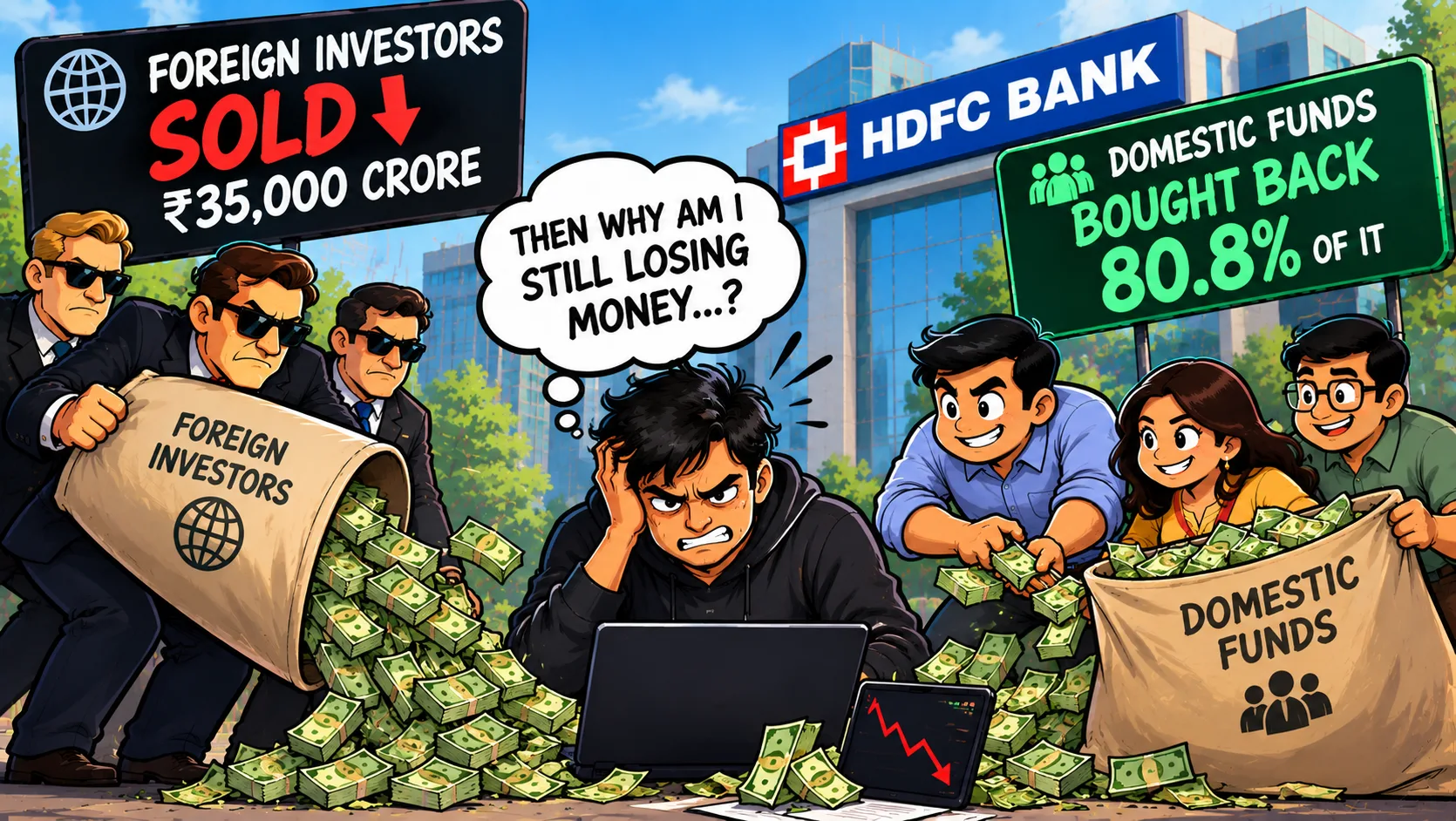
Foreign investors have spent four consecutive quarters reducing their position in one of the most widely held names in Indian financials. The sharpest cut came in the quarter ended March 2026, when foreign portfolio investorsiOverseas funds and institutions that buy listed Indian securities. Exchanges and data providers often still label the category FII. shed 47.95 crore shares and their holding fell from 47.67% to 44.05% — a move widely reported as ₹35,000 crore of selling. The stock fell 26.2% over the same quarter, its steepest quarterly decline since the March 2020 quarter.
That is the headline. On its own, it reads like a verdict on the bank.
The register says something more specific. In the same quarter, domestic mutual funds bought 38.67 crore shares and lifted their stake from 26.66% to 29.54%, their fifth consecutive quarterly increase. Two blocks of professional money looked at the same disclosures in the same three months and moved in opposite directions, at almost the same size.
In this piece we work through what is actually established — two governance episodes, a set of merger-integration metrics, and a shareholder rotation — and separate each from what has been inferred on top of it. But first, the numbers everyone is quoting.
How much did FIIs actually sell, and who bought it?

Show the full table — 3 rowsHide the full table
| Register movement, Q4 FY26 | Shares, crore | ₹ crore, as reported | Holding, Dec-25 | Holding, Mar-26 | Change |
|---|---|---|---|---|---|
| Foreign portfolio investors | −47.95 | −35,000 | 47.67% | 44.05% | −3.62 pp |
| Domestic mutual funds | +38.67 | +28,293 | 26.66% | 29.54% | +2.88 pp |
| Net, the two blocks | −9.28 | −6,707 | 74.33% | 73.59% | −0.74 pp |
The table and chart above show both sides of the March-quarter register. However you measure them, the two legs are close in size. On the bank’s own shareholding filing, domestic mutual funds absorbed 79.6% of the foreign reduction (2.88 against 3.62 percentage pointsiThe plain difference between two percentages. A move from 47.67% to 44.05% is 3.62 percentage points, not a 3.62% change.). On share counts it is 80.6% (38.67 crore against 47.95 crore); on the widely reported rupee figures, 80.8%. [derived]
Three bases, one answer: about four-fifths.
The rupee figures do need a caveat, because at first sight they don’t reconcile with HDFC Bank’s market capitalisation. They do once you account for two things:
-
a)
The price. ₹35,000 crore divided by 47.95 crore shares is ₹730 a share; ₹28,293 crore divided by 38.67 crore shares is ₹732. The stock closed 2025 at ₹991.20 and fell 26.2% in the quarter, which puts the 31 March close near ₹731. [derived] So both rupee figures are share-count changes valued at roughly the quarter-end price — not the rupees that changed hands during a quarter in which the stock mostly traded higher. A separately reported estimate of ₹43,085 crore for the same shares works out to about ₹898 each, closer to an average for the quarter.
-
b)
The base. The filing expresses category holdings as a share of 1,333.7 crore shares, not the 1,539.3 crore in issue. The 205.7 crore shares held by the depositary against the bank’s American Depositary ReceiptsiUS-listed certificates backed by Indian shares held by a depositary bank. HDFC Bank’s are held through JP Morgan Chase and sit outside the base used for category percentages. — 13.4% of the equity — sit outside that base. With both adjustments the arithmetic closes: 3.62% of 1,333.7 crore is about 48.3 crore shares, which at ₹730 is about ₹35,200 crore. [derived]
So the rupee amounts are best read as a range: roughly ₹35,000–43,000 crore of foreign selling and ₹28,300–34,700 crore of mutual-fund buying, depending on the price used. The percentage-point changes remain the cleanest numbers in this piece.
A rotation of the shareholder base is not the same event as a reduction in ownership.
It means the shares changed hands between two categories of institution — and that a domestic bid existed at the prices foreign investors were selling into. A uniform de-rating, where every category reduces and the register shrinks against a thinner bid, looks different in the data. This is not that.
One qualification on “foreign”: the 44.05% excludes ADR holders. Counting them, foreign ownership was 51.80% of the bank at end-March, down from 54.95% in December, against a board-approved foreign investment limitiThe ceiling on total foreign ownership that a company has approved, within the sectoral cap. HDFC Bank’s is 74%. of 74%.
Which leaves the obvious question: what were foreign investors reacting to?
What happened in the leadership transition?
Part-time Chairman Atanu Chakraborty resigned on 18 March 2026, stating that certain happenings and practices within the bank over the previous two years were not in congruence with his personal values and ethics. He did not specify the practices concerned.
An independent legal review followed, commissioned by the board within days and conducted over roughly three months by Wilson Sonsini Goodrich & Rosati and Wadia Ghandy & Co. Its conclusion, announced on 26 June 2026, was that the contemporaneous evidence reviewed was inconsistent with his statement and that it identified no basis for it.
Mr Chakraborty did not participate in the review despite repeated requests; he has said he declined because the bank did not share the review’s terms of reference or its legal basis. Whatever the reason, his absence is the single most consequential detail in the sequence, because it bounds what the review could have established either way.
A review that found no basis for the statement and a former chairman who declined to be interviewed are two different facts. Only the first has been established; the second is why the first settles less than it appears to.
The chairman’s seat itself has since been filled. Keki Mistry, previously HDFC Limited’s vice chairman and CEO, served as interim part-time chairman from 19 March 2026, with his term later extended to 18 September 2026 or until a regular appointment. On 15 July 2026 the RBI approved Rajiv Kumar — a former Chief Election Commissioner and Finance Secretary — as part-time chairman for three years; Mr Mistry continues on the board as a non-executive, non-independent director.
A second governance matter ran alongside. After a newspaper report on 27 May 2026 that the bank had paid about ₹45 crore to the Maharashtra State Road Development Corporation, booked as marketing spend, in connection with its deposits, a special disciplinary committee of independent directors reviewed the 2017 and 2021 arrangements. On 27 July the bank disclosed that its board, meeting on 23 July, had concluded the conduct was business overreach rather than mala fide action or personal enrichment — but it noted a possible divergence from RBI directions, communicated the matter to the RBI, and imposed warning letters and a ₹1 lakh penalty each on the MD & CEO, the CFO and the group head of retail assets.
The RBI has since reportedly asked the bank to explain the basis for those penalties and brought forward its own supervisory review of the arrangement. A securities class actioniA lawsuit filed on behalf of a group of investors alleging misleading disclosures. Filing one establishes nothing; the claims are tested later, if at all. has also been filed in New York on behalf of purchasers of the bank’s US-listed securities between 17 July 2023 and 26 May 2026; its claims are allegations and have not been tested.
| Date | Event | Days elapsed |
|---|---|---|
| 18 Mar 2026 | Part-time Chairman Atanu Chakraborty resigns | — |
| 26 Jun 2026 | External legal review concludes; finds no basis for the statement | 100 days |
| 15 Jul 2026 | RBI approves Rajiv Kumar as part-time chairman | 119 days |
| 23 Jul 2026 | Board penalises MD & CEO, CFO and a group head over MSRDC deposits (disclosed 27 Jul) | 127 days |
| 31 Jul 2026 | RBI reportedly seeks an explanation of the penalties; advances its own review | 135 days |
| 29 Aug 2026 | MD & CEO decides not to seek reappointment | 164 days |
| 10 Sep 2026 | This update. Chairman seat filled; CEO successor not yet named | 176 days |
| 26 Oct 2026 | MD & CEO’s term concludes | 222 days |
Source: HDFC Bank exchange disclosures (18 Mar, 23 Jul); Business Standard (26 Jun, 15 Jul, 27 Jul, 29 Aug); Outlook Business (31 Jul); IndMoney (26 Oct). Days elapsed are our calculation from 18 March 2026.
Then, on 29 August 2026, the board took note of Managing Director and Chief Executive Sashidhar Jagdishan’s decision not to seek reappointment; the bank said he held to it despite the board’s persuasion. His term concludes on 26 October 2026, six years after he took charge, and the board has said it will fast-track the succession.
Deputy Managing Director Kaizad Bharucha is the internal candidate most cited by brokerages, though the RBI’s 15-year limit for whole-time directorsiDirectors who are also full-time executives of the bank. RBI rules cap how long one person can hold such a role at the same bank at 15 years., counted from his 2014 board appointment, would cap his tenure at under three years. Executive Director V Srinivasa Rangan and chief credit officer Jimmy Tata have also been named. Reported external names include Dinesh Khara (former chairman, State Bank of India), Amitabh Chaudhry (MD & CEO, Axis Bank), Anup Bagchi (MD & CEO, ICICI Prudential Life) and Vibha Padalkar (MD & CEO, HDFC Life).
Bloomberg has reported, citing people familiar with the matter, that the new chairman had pressed for changes including faster loan growth and a reshuffle of senior executives, and that he favours an external candidate. Search firms including Egon Zehnder are reported to be in talks for the mandate, and whoever the board picks needs RBI approval. As at the date of this update, 46 days remain on the term and no successor has been named.
What can reasonably be said is narrow: an allegation was made without particulars, an independent review did not substantiate it, a separate internal review did find overreach in a deposit arrangement and penalised the chief executive for it, and the two most senior positions at the bank turn over inside eight months. Anything beyond that — including the direction of causation between the governance episodes and the foreign selling — is inference, and the register does not date-stamp motive.
Governance is one half of the story. The other half is in the numbers.
Have the merger-integration metrics recovered?
The merger of HDFC Limited into HDFC Bank, effective 1 July 2023, created one of India’s largest financial institutions by balance sheet. Three years on, one of the two headline return measures is roughly where it was before the merger. The other is not.

Show the full table — 3 rowsHide the full table
| Return metric | Pre-merger avg, FY19–23 | FY26 | Q1 FY27 | FY28E (MOFSL) | Gap, FY26 vs avg |
|---|---|---|---|---|---|
| Return on assets | 2.0% | 1.9% | 1.85% | 1.9% | −0.1 pp (−5%) |
| Return on equity | 16.8% | 14.3% | 13.8% | 14.9% | −2.5 pp (−15%) |
| Net interest margin, on total assets | — | 3.38% (Q4) | 3.26% | — | compressed |
The table and chart above show HDFC Bank’s return ratios against their pre-merger range, using the bank’s own Q1 FY27 presentation. Against the five-year pre-merger average, return on assetsiProfit as a percentage of everything on the balance sheet — loans, investments and cash. is about 5% lower and return on equityiProfit as a percentage of the shareholders’ capital that produced it. about 15% lower on FY26 figures, and the equity gap widened to about 18% in the June 2026 quarter. [derived]
That distinction matters more than either number.
Return on equity is return on assets multiplied by leverageiHere, total assets divided by shareholders’ equity: how many rupees of balance sheet each rupee of equity supports.. If return on assets has barely moved, most of the equity shortfall has to come from leverage. On our arithmetic, the bank now carries about 7.5 rupees of assets per rupee of equity, against about 8.4 before the merger. [derived]
That describes a bank holding more capital per unit of business — its CET1iCommon Equity Tier 1. A bank’s highest-quality capital, mainly shareholders’ equity, measured against its risk-weighted assets. ratio was 17.4% in June 2026, against 16.4–16.9% in FY20–FY23 — rather than one earning less on its assets. Holding capital constant, a move from 16.8% to 14.3% is about 15% less profit per rupee of equity. Nothing in that says the bank is impaired, and asset quality has been broadly stable, with gross NPAs at 1.17% in June.
The bank is not earning much less on its assets. It is holding much more capital against them.
That does not mean the asset side is untroubled. The bank’s net interest marginiThe spread between what a bank earns on its loans and investments and what it pays for deposits and borrowings, expressed against its earning assets. fell to 3.26% on total assets in the June 2026 quarter from 3.38% in March — its lowest on record — as the yield on assets eased to 7.7% from 7.8% while the cost of funds held at 4.4%. The CASAiCurrent Account and Savings Account deposits. The cheapest funding a bank has, because these balances pay little or no interest. ratio slipped to 32% from 34% in March (and from 38% in September 2023), though borrowings, the costliest legacy of the merger, are down to 11% of liabilities from 21%.
A peer comparison shows the size of the gap: ICICI Bank reported return on equity of 17.1% and return on assets of 2.49% for the same quarter. And the one FY28 estimate cited here — Motilal Oswal’s 14.9% return on equity — does not expect the gap to close.
So does a lower foreign stake mean foreign investors have turned on the bank?
Does a lower FII stake mean a negative view of the bank?
Not necessarily, and the distinction is worth holding onto. A reduction in foreign institutional holding is consistent with at least three explanations that carry very different implications:
- a)
A bank-specific view — foreign investors concluded something about HDFC Bank's governance, integration or earnings trajectory that domestic funds did not. This is the reading the headline invites.
- b)
A relative-allocation decision — foreign capital rotated toward other Indian equities, other markets or other asset classes on a comparative basis, with no particular view of the issuer. A position this large is a natural funding source for any reallocation, precisely because it is liquid enough to exit.
- c)
A portfolio-construction constraint — HDFC Bank carries one of the highest levels of foreign ownership among Indian financials — 51.80% including ADR holders at end-March — which makes it a structurally over-weighted position in many foreign mandates and a routine candidate for trimming when weights are rebalanced.
The June quarter adds some evidence for the second and third readings without settling them. Foreign investors pared holdings in 17 banks that quarter, most heavily in the largest and most foreign-owned names — Axis Bank’s foreign holding fell 2.09 percentage points and ICICI Bank’s 0.69 — while adding to 11 smaller private lenders. Analysts quoted by Business Standard put the fall in foreign ownership of Indian equities overall at about 300 basis points between September 2025 and June 2026.
The register cannot distinguish between these. What it does establish is that whichever of them was operating, a domestic institutional bid absorbed four-fifths of the March-quarter outflow at prices that were 26.2% lower over the quarter. That is a fact about liquidity and about the composition of the shareholder base. It is not a fact about valuation, and it is not a forecast.
Which brings us to what has happened since.
What would change the reading?
Of the three variables this piece set out to watch, two have since moved, and the third — the succession — is still open.
First, the succession. A named successor before 26 October removes the largest open variable, and an internal appointment reads differently from an external one.
Second, the next register. It fell again. Foreign holding declined a further 2.22 percentage points to 41.83% in the quarter ended June 2026, a fourth consecutive quarter of reduction, while domestic institutional holding rose to 41.92% and mutual-fund holding to about 30.6%.
Third, the margin line. Net interest margin compressed to 3.26% in the June 2026 quarter as HDFC Bank reported standalone profit of ₹19,059.7 crore, below the ₹19,332 crore Street estimate, with return on equity of 13.8%. The stock closed at ₹687.10 on 9 September, a 52-week low and about 31% below its 2025 close. [derived from closing prices]
That is a continuation of the pattern this piece describes, not a reversal of it.
With two of the three variables resolved in the direction the register already pointed, the honest summary is the one the data supports and no more: a governance episode an independent review did not substantiate, a second in which the board itself found overreach, a chairman’s seat that has since been filled while the chief executive’s has not, a return on equity that remains below pre-merger levels mainly because the bank carries more capital, a margin that is still compressing, and a shareholder-base rotation between foreign and domestic holders that has continued into a fourth quarter rather than reversing.